

By Laura Garcia-Pupo, PhD February 19, 2026
Years spent in transcriptomics had trained me to deal with genomic datasets that could swallow a person whole. Through the years, Python became my favorite programming language to handle my research data. But today, while chasing evidence in the literature, I met a problem that refused to yield to experience alone and required a precious time I didn’t have. A simple MeSH search in PROSPERO became a flood, thousands of systematic review protocols trapped inside a stubborn ris file. EndNote reference manager misunderstood it outright, leaving me with a digital brick instead of usable knowledge. And so I found myself scrolling endlessly, wondering how I could efficiently squeeze the information I needed:
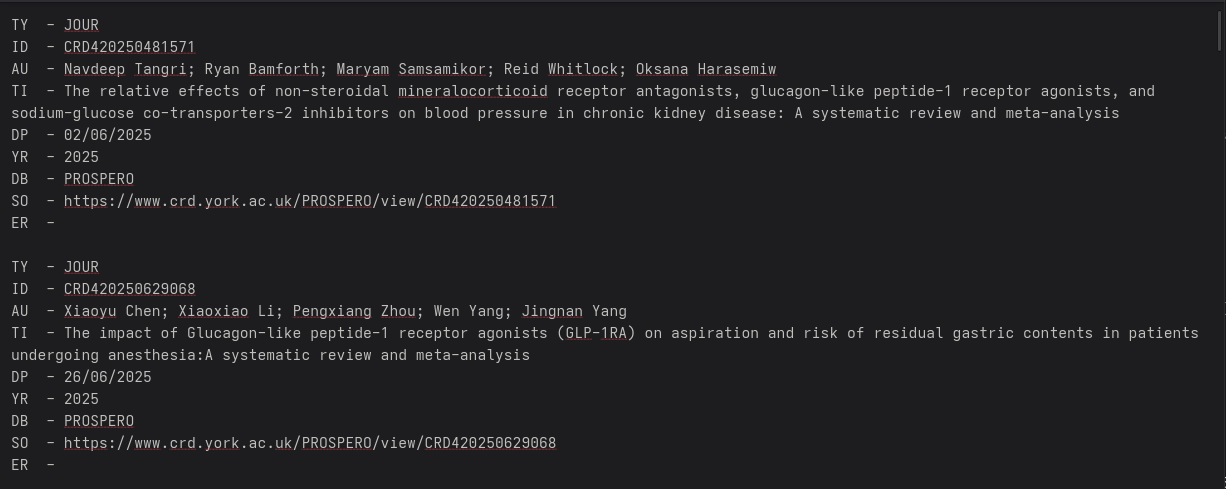
In a world where genAI is pitched as the cure‑all, I’ve grown wary of promises that sparkle but don’t deliver. Every industry seems convinced that prompts can fix anything, yet separating real value from noise feels harder each day. But today, Copilot liberated me from the tedious and time-consuming task of manually organizing my huge .ris file of systematic review protocols.
Let’s take a look back at the prompt I used and try to generalize it, so it might serve you while facing a similar problem. I used some best practices that guide Copilot into the results I need, instead of leaving the solution open to the computer’s “imagination”.
I started with these instructions:

First, I set the “persona” by thinking of the specialist I wish I were to solve the problem: You are an expert software developer, specialized in Python. By telling Copilot from what perspective I’m expecting it to solve the problem, I’m already accessing the part of the body of knowledge of the model (GPT-5.1 in this case) that interests me the most to solve this problem.
Then, I describe the task as precisely as possible: what will be the input format, what will be the output format, and how the file is composed. Finally, I’m asking Copilot to demonstrate its understanding of the problem by asking if it is Ready. The answer confirms that it understood the problem, and that it is ready to take the input file:

Ok, great! At that point, I uploaded the file and asked for a first run, but I instructed it not to reveal the code yet, to avoid losing focus on the solution. It is essential to keep the questions closed and guide Copilot one step at a time to get the best results.
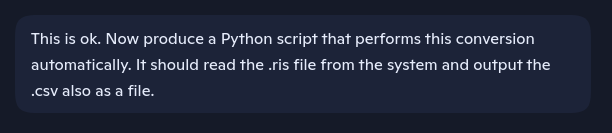
Then there was a simple problem: the file was too big for Copilot to process. Ok, there was a solution. Since the format of the records in the .ris file is always the same, the problem could be solved with a small sample, let’s say, the first 10 records. This is small enough for Copilot to handle. Once the output was correct for the small sample, I asked for the full source code to run it on my laptop on the full .ris file.
Here is the generated Python script:
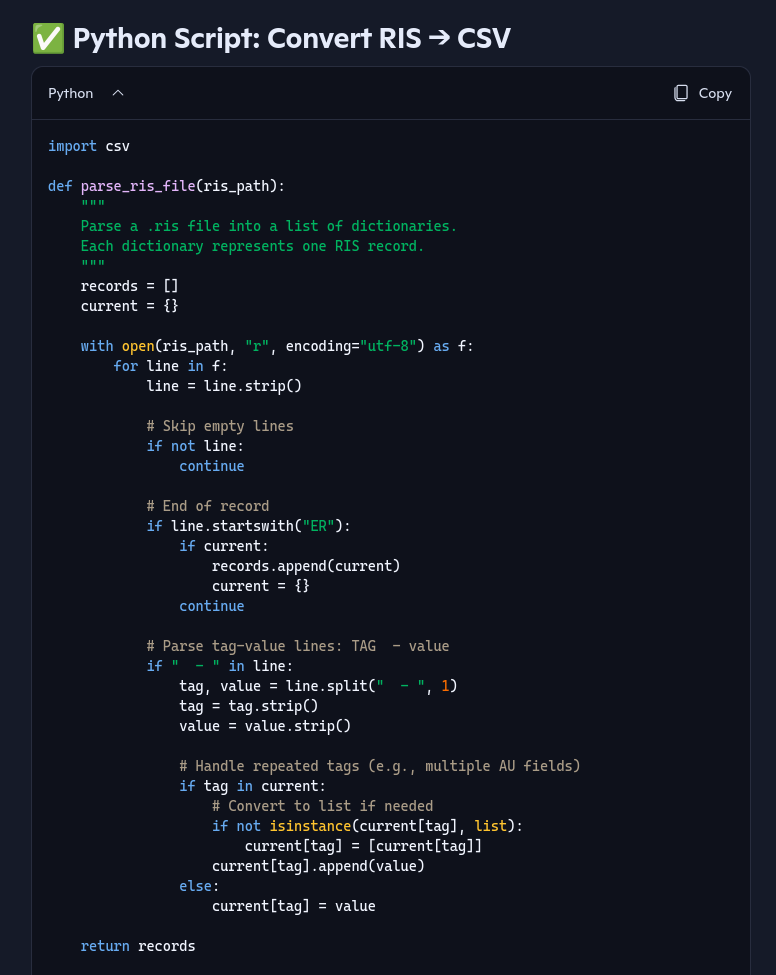
To run the Copilot-generated Python script on my laptop, first I pasted it into my preferred code editor, Geany , and changed the names of the input and output files (yellow circles in the picture above). Then, I saved it as a .py file in the same folder where my original .ris file was and pressed F5 to run the command.
Voilá! After 15 minutes from downloading my .ris file from the database, I have a .csv file with articles I can actually filter and import to my reference manager. So, in summary, if you face a challenge like this, my tips are:
- Set a persona
- Define the problem with precision: define the format, the actions, and the expected output.
- Instruct one step at a time, and check that the output is the expected before moving forward to the next step
- Define the structure of the output by constraining the valid solutions to what you need.
- Assess the suggestions that Copilot gives after every prompt: you don’t need to follow them if they are misaligned with the solution of your problem.
Maybe that’s why it’s called Copilot, because for better results, you should be the real pilot.